Author Archives: Bhawesh Kumar

Implementation Roadmap: From Static LLMs to Autonomous Agent Systems

By | September 28, 2026

Phase 1: Strengthening the AI Engine—From Discrete Text to Vectorized Meaning In the modern enterprise, the transition from keyword-based text processing to high-dimensional semantic understanding is a strategic necessity. Traditional architectures failed to capture the profound nuances of language, where the meaning of a word fluctuates based on context and author intent. To construct true… Read More »
Production-Ready RAG: Architecting the Enterprise Knowledge Engine

By | September 27, 2026

1. Introduction: The Shift from Demo to Deployment The rapid proliferation of local inference tools like Ollama has made it possible for any developer to stand up a “naive RAG” (Retrieval-Augmented Generation) demo in minutes. However, in the enterprise, the distance between a functional demo and a production-grade Knowledge Engine is measured in architectural reliability.… Read More »

Beyond the Blueprint: 5 Counter-Intuitive Realities of Modern Enterprise Architecture

By | May 21, 2026

For years, Enterprise Architecture (EA) has been where innovation goes to die – buried under a mountain of “shelf-ware” diagrams and rigid technical bottlenecks. To the average business leader, the architect is the ultimate gatekeeper: the person whose job is to say “no” because a new idea doesn’t fit a five-year-old blueprint. It is time… Read More »

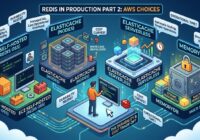
Redis in Production Part 2: ElastiCache, MemoryDB, and the Self-Hosted Question

By | April 23, 2026

Prerequisites You should read Part 1: Redis in Production — Persistence, Replication, and HA first, or already understand RDB vs AOF, Redis Sentinel, and Redis Cluster mode. Basic AWS familiarity (VPCs, security groups, EC2 instance families) is expected. You don’t need prior hands-on experience with MemoryDB or ElastiCache Serverless. The Problem: “Just Use ElastiCache” Is… Read More »

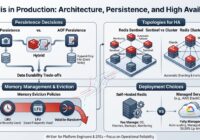
Redis in Production: Architecture, Persistence, and High Availability

By | April 23, 2026

TL;DR: Redis is simple to start but tricky to run correctly at scale. This guide covers the production deployment decisions that matter: RDB vs AOF vs hybrid persistence, Sentinel vs Cluster topologies, memory eviction policies that won’t kill your app, and the self-hosted vs ElastiCache trade-off. Written for platform engineers who need Redis to stay… Read More »

Production Multi-Agent Systems: Architecture Patterns That Actually Work

By | April 23, 2026

TL;DR: Most production “AI agents” are actually deterministic workflows — and that’s fine, but the architecture decision you make right now determines whether your system costs $0.10 or $50 per request, whether it completes in 3 seconds or 3 minutes, and whether you can debug it when it fails at 2am. This post maps Anthropic’s… Read More »

AI Systems That Learn Without Being Trained: The Rise of Self-Evolving Architectures

By | January 3, 2026

We are entering an era where the most powerful AI systems are not trained—they evolve. The intelligence no longer lives in the model, but in the architecture surrounding it. The AI landscape has reached an inflection point. While the industry obsesses over model parameters and training datasets, a quiet revolution is underway: the emergence of… Read More »

Backend for Frontend (BFF) on AWS — AppSync/GraphQL + Lambda Resolvers

By | December 31, 2025

What you’ll learn The problem BFF solves If multiple clients (web, mobile, partner apps) call the same “generic” backend, you often end up with: Backend for Frontend (BFF) fixes this by creating a backend tailored to a specific frontend: BFF in one sentence A BFF is a client-specific backend that aggregates and shapes data exactly… Read More »

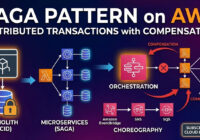
Saga Pattern on AWS — Distributed Transactions with Compensation

By | December 31, 2025

What you’ll learn The problem: distributed transactions without a 2PC In a monolith, you might wrap changes in a single database transaction. In microservices (or distributed systems), a single business action often spans multiple components: You can’t easily use a single ACID transaction across multiple independent datastores and services (and you generally shouldn’t). Saga is… Read More »

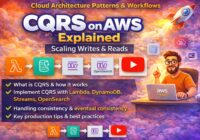
CQRS on AWS Demystified: From Commands to Queries with Serverless Architecture

By | December 31, 2025

What you’ll learn Video discussion on YouTube – https://youtu.be/2lFW5H3ZzLA The problem CQRS solves In many systems, we try to make one database schema do everything: As the system grows, that single model starts to hurt: CQRS (Command Query Responsibility Segregation) is a pattern that says: CQRS in one sentence CQRS separates the write path (commands)… Read More »