


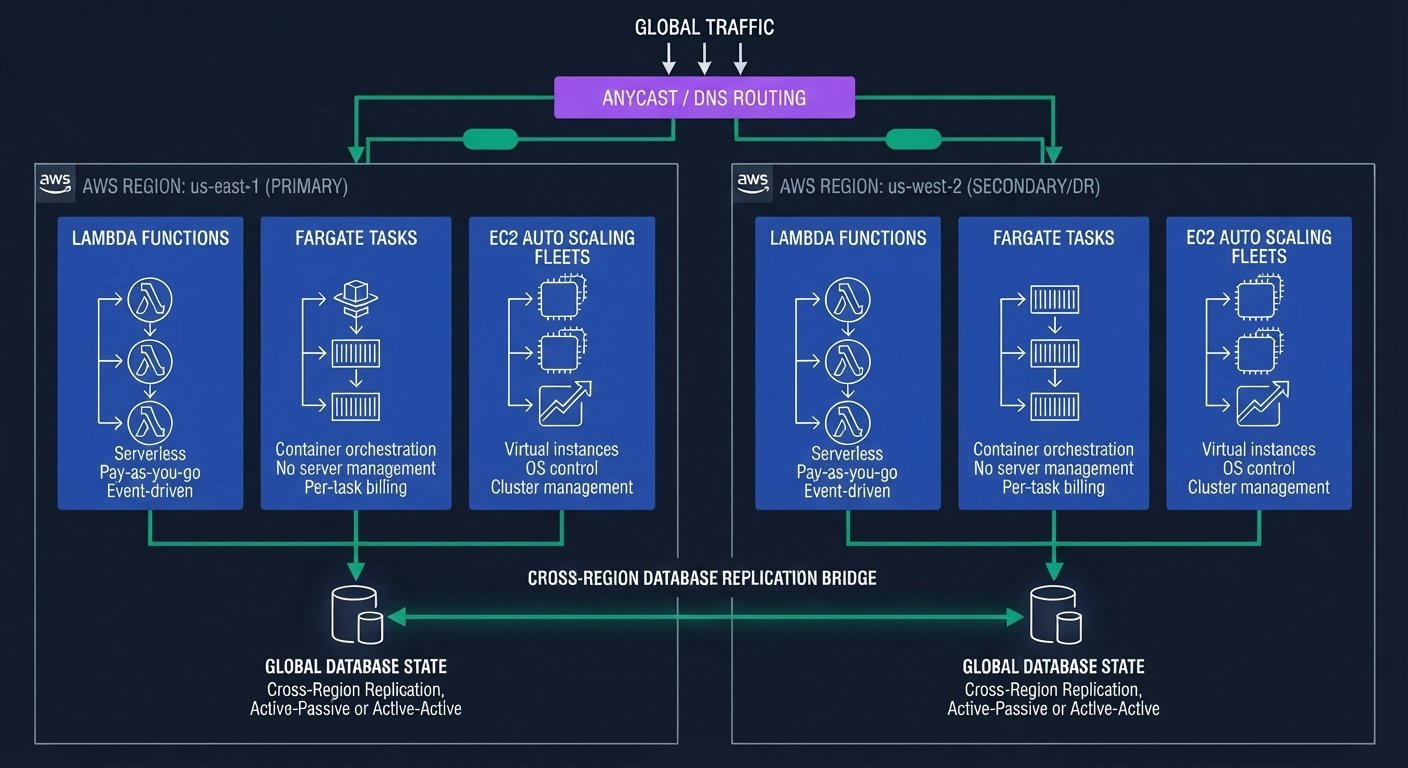
Introduction
A single-region Availability Zone outage is an infrastructure hiccup. A regional control-plane failure—or a bad deployment that takes down us-east-1—is a company-wide incident.
Yet when engineering teams design multi-region APIs on AWS, they almost always start with the wrong question: “Should we use Lambda, Fargate, or EC2?”
In isolation, all three can serve production HTTP traffic reliably. The real divergence only shows up when you introduce multi-region disaster recovery (DR), cross-region state synchronization, and real production traffic curves. At low duty cycles, running multi-region EC2 clusters can burn cash on idle capacity. At sustained high throughput, API Gateway plus Lambda can become much more expensive than a right-sized, discount-backed ECS cluster—and a misconfigured NAT Gateway or chatty cross-AZ service call can wipe out your compute savings overnight.
This guide breaks down how to architect Lambda, ECS Fargate, and ECS on EC2 for multi-region AWS APIs with DR, models workload-dependent cost crossover points, and provides ready-to-render PlantUML C4 diagrams with official AWS icons.
Source Transparency Note: Architectural patterns and DR classifications are grounded in AWS documentation. Pricing in this article is a snapshot of public us-east-1 list rates and should be treated as an estimating baseline, not a quote or a complete bill. Monthly estimates exclude taxes, discounts, database capacity, logs, cache capacity, public IPv4 addresses, PrivateLink charges, and region-specific data transfer. Verify current rates in the AWS Pricing Calculator before making purchasing decisions.
The Problem
Moving an API from Multi-AZ to Multi-Region changes the rules of distributed systems engineering. Inside a single AWS Region, Availability Zones are separated by up to 100 km over low-latency, high-bandwidth fiber, making synchronous replication and cross-AZ load balancing relatively painless.
Across AWS Regions, three harsh realities break single-region assumptions:
- Failover Physics vs. DNS Caching: Relying solely on Amazon Route 53 health checks exposes clients to DNS TTL and resolver caching. For traffic that must fail over without waiting for DNS propagation, consider AWS Global Accelerator or a stateful edge/origin design—each has different protocols, constraints, and cost.
- Idle DR Capacity Tax: In an Active-Passive (Pilot Light or Warm Standby) topology, secondary-region compute either sits partially idle or must scale rapidly during a regional outage. How Lambda, Fargate, and EC2 scale from zero (or standby) under a sudden 100% regional traffic shift is radically different.
- The Hidden Networking & Replication Multiplier: Cross-region data transfer (
$0.02/GBbetween most regions,$0.01/GBbetweenus-east-1andus-east-2), cross-AZ EC2 chatter ($0.01/GBeach direction), NAT Gateway processing ($0.045/GB), and replicated database writes often rival or exceed raw compute spend.
Think About This If
us-east-1fails at peak traffic and 100% of requests swing tous-west-2within 15 seconds, will your secondary compute tier absorb the thundering herd—or will cold-start limits, slow EC2 AMI boot times, or container image pulls trigger a cascading brownout?
The Mental Model
Stop evaluating AWS compute options solely on per-hour instance rates. Instead, evaluate multi-region API platforms as Three Planes of Recovery:
- The Edge Plane (Traffic Steering): Decides where bytes enter AWS—via DNS (
Route 53), Anycast IP (AWS Global Accelerator), or HTTP edge caching (CloudFront). - The Compute Plane (Elasticity & Blast Radius): Executes stateless API logic using either Micro-execution Functions (
Lambda), Serverless Containers (ECS Fargate), or Managed VM Fleets (ECS on EC2). - The State Plane (RPO & Consistency): Replicates persistent data across regions—either asynchronously with multi-active writes (
DynamoDB Global Tables) or via storage-level replication (Aurora Global Database).
Key Insight Compute elasticity determines Recovery Time Objective (RTO) during a traffic surge; cross-region data replication determines Recovery Point Objective (RPO). Optimizing compute without matching your edge routing and database failover guarantees a broken DR drill.
Architecture Walkthrough
C4 Level 1: System Context (Global Multi-Region Entry)
Before zooming into compute choices, all three architectures share a common global context: external API consumers connect over TLS to a global routing layer that continuously monitors regional health and routes requests across primary and secondary AWS regions.
Option 1: AWS Lambda Multi-Region APIs with DR (C4 Level 2 Container Diagram)
How the Architecture Works
In a serverless multi-region API, Amazon API Gateway (HTTP API or Regional REST API) sits in front of AWS Lambda functions deployed identically across both us-east-1 and us-west-2. Amazon Route 53 (or CloudFront origin failover) evaluates regional API Gateway health check endpoints and shifts traffic automatically on failure. State is stored in Amazon DynamoDB Global Tables for multi-active, low-latency reads and writes across regions.
Because Lambda executes purely on demand and scales automatically from near-zero requests to thousands per second, it enables an Active-Active (or zero-idle Pilot Light) DR posture where the secondary region costs virtually $0 in compute until failover occurs (unless Provisioned Concurrency is enabled). Note also that Lambda functions placed inside a VPC that only need S3 or DynamoDB should use VPC Gateway Endpoints rather than a NAT Gateway to avoid unnecessary hourly and per-GB NAT fees.
Benefits & Issues of Lambda Multi-Region APIs
- Benefits:
- Near-Zero Idle DR Cost: You pay only for requests and execution duration (
1 msgranularity), eliminating idle secondary-region compute bills in Active-Passive setups. - Zero OS/Host Patching: AWS manages the runtime, AZ distribution, and scaling automatically across Availability Zones.
- Built-In Multi-AZ Fault Tolerance: Lambda functions execute across multiple AZs natively without managing Auto Scaling Groups or target groups.
- Near-Zero Idle DR Cost: You pay only for requests and execution duration (
- Issues & Limitations:
- Cold Starts During Failover Spikes: When 100% of traffic abruptly hits a previously idle secondary region, concurrent cold starts can spike tail latency (
p99). Mitigating this with Provisioned Concurrency erases the pay-per-use idle advantage because you pay continuously whether invoked or not. - Hard Platform Ceilings: Standard Lambda event functions enforce a 15-minute maximum execution timeout and regional account concurrency quotas. API Gateway and Lambda also impose separate request and response limits: Lambda synchronous invocation request and response payloads are 6 MB (for supported event and function types), while API Gateway applies its own HTTP API/REST API limits. Quotas can be exhausted by a sudden failover surge if they are not reviewed and increased in the DR region beforehand.
- API Gateway Request Tax at High Volume: API Gateway charges
$1.00/Mfor HTTP APIs or$3.50/Mfor REST APIs on each received API call, regardless of payload size. For sustained traffic, the per-request charge can narrow or eliminate Lambda’s cost advantage relative to an ALB.
- Cold Starts During Failover Spikes: When 100% of traffic abruptly hits a previously idle secondary region, concurrent cold starts can spike tail latency (
Option 2: ECS Fargate Multi-Region APIs with DR (C4 Level 2 Container Diagram)
How the Architecture Works
In a serverless container architecture, AWS Global Accelerator (or Route 53) sits in front of regional Application Load Balancers (ALBs) across us-east-1 and us-west-2. The ALB distributes requests across ECS Service tasks running on AWS Fargate, spread across private subnets in multiple Availability Zones. State is backed by Amazon Aurora Global Database, which uses storage-level cross-region replication and typically recovers in the order of minutes, or DynamoDB Global Tables. Neither database replication mechanism should be described as an RPO or RTO guarantee.
Fargate eliminates EC2 host management, OS patching, and cluster capacity planning. In a Warm Standby DR model, the secondary region runs a minimal baseline (e.g., 2 small tasks across 2 AZs) and relies on ECS Service Auto Scaling (Target Tracking on ALBRequestCountPerTarget or CPU) to spin up additional Fargate tasks automatically upon failover.
Benefits & Issues of ECS Fargate Multi-Region APIs
- Benefits:
- Zero Control Plane Fee & Zero Host Management: Unlike EKS (
$0.10/hror~$73/monthper cluster in standard support), ECS carries$0control-plane cost, and Fargate eliminates OS patching, AMI rotation, and EC2 capacity management. - Predictable Container Portability & Long Connections: Supports arbitrary runtimes, WebSockets, gRPC streaming, and long-running API requests without Lambda’s 15-minute ceiling.
- Automated Failover Scaling: Fargate auto-scales tasks directly without waiting for EC2 instances to boot and join an ECS cluster.
- Zero Control Plane Fee & Zero Host Management: Unlike EKS (
- Issues & Limitations:
- Per-Unit Compute Premium: Fargate charges roughly 15–40% more per vCPU/GB than densely packed EC2 instances at steady state.
- Image Pull Latency on Scale-Out: During a sudden failover surge, new Fargate tasks must pull container images from ECR and pass ALB health checks (typically 30–90 seconds)—mitigable by keeping minimal Warm Standby tasks running and using ECR Cross-Region Replication + Seekable OCI (SOCI) lazy loading.
- Standing Network Overhead: Every active Fargate region still incurs fixed standing charges for ALBs (about
$16.43/monthfor an idle baseline in common US estimates) and NAT Gateways (about$32.85/monthper AZ, before processing charges). Private endpoints or Gateway endpoints can remove or reduce some of these costs.
Option 3: ECS on EC2 Multi-Region APIs with DR (C4 Level 2 Container Diagram)
How the Architecture Works
In an ECS on EC2 deployment, you retain the free ECS control plane while running tasks on a customer-managed fleet of EC2 instances (e.g., Graviton c7g/m7g or Intel m7i instances) managed via ECS Capacity Providers and EC2 Auto Scaling Groups (ASGs) spanning 2+ AZs.
Because you control the host VMs, you can bin-pack multiple microservice containers onto shared instances, attach EBS volumes or NVMe instance stores, use GPU instances for AI inference APIs, and stack Compute Savings Plans (up to 66–72% off) with EC2 Spot Instances (using Automated Spot Instance Draining).
Benefits & Issues of ECS on EC2 Multi-Region APIs
- Benefits:
- Lowest Unit Cost at Sustained Scale: High-density bin-packing combined with 1-year/3-year Compute Savings Plans (up to 66–72% discount) or EC2 Spot fleets (up to 70–80%+ discount) yields the lowest cost per request for steady, high-RPS APIs.
- Full Host, Hardware, and Kernel Control: Supports GPU instances, high-memory/NVMe families, persistent EBS mounts, daemon sidecars, and sysctl/TCP stack tuning.
- Local In-Memory / NVMe Caching: Because hosts persist across requests, services can maintain warm in-process caches or sidecar Redis/Envoy proxies without external hop latency.
- Issues & Limitations:
- Two-Layer Scaling Lag in DR: During failover, ECS must first wait for the EC2 Auto Scaling Group to launch new VMs, boot the OS, register the ECS agent, and then schedule container tasks—resulting in slower recovery than Fargate or Lambda unless you keep substantial Warm Standby headroom.
- Highest Operational Overhead: Your team owns AMI patching, host security hardening, Docker daemon maintenance, ENI IP exhaustion planning (
awsvpctrunking limits), and Spot interruption handling. - Idle Fragmentation Waste: Unless bin-packing is tuned continuously, partially empty EC2 hosts leave stranded CPU/RAM you still pay for 24/7.
Deployment & Automated Failover Sequence
How does failover actually execute across the Edge, Compute, and State planes when us-east-1 degrades? Below is the end-to-end PlantUML sequence diagram with AWS icons showing automated detection, traffic cutover, database promotion, and compute scaling.
Real-World Implementation: Edge Routing, DR Patterns, and State
1. Route 53 vs. AWS Global Accelerator vs. CloudFront
Choosing the front door determines your actual failover RTO:
- Amazon Route 53 (DNS Failover / Latency-Based Routing): Costs pennies per health check and million queries, making it ideal for cost-sensitive Lambda + API Gateway stacks. However, failover depends on DNS TTL expiration (often 60 seconds in theory, 2–5 minutes in practice due to stubborn ISP/client DNS caches).
- AWS Global Accelerator: Allocates two static Anycast IPs at AWS edge locations globally. Traffic enters the AWS private backbone immediately and fails over to a healthy secondary ALB/NLB in seconds without waiting for DNS caches to expire. It bills
$0.025/hour($18.25/monthper accelerator) plus a per-GB Data Transfer-Premium (DT-Premium) fee and public IPv4 charges. - Amazon CloudFront Origin Failover: Works in front of API Gateway or ALBs, supports edge caching and AWS WAF, and can automatically fail over based on configured origin response codes. Cacheable content may reduce origin requests and internet egress, but dynamic APIs should be modeled from the current CloudFront and origin egress rates rather than assumed to be cheaper.
2. Active-Active vs. Warm Standby vs. Pilot Light
| DR Pattern | How It Works | Typical RTO / RPO | Best Compute Fit |
|---|---|---|---|
| Pilot Light | Core database replication runs in the DR region; compute is off (0 tasks/EC2) or uninvoked (Lambda) until failover. | RTO: Minutes to tens of minutes, workload-dependent; RPO: replication-lag-dependent | AWS Lambda (serverless Pilot Light scales automatically on traffic without pre-provisioning) |
| Warm Standby | Scaled-down production stack runs 24/7 in the secondary region and auto-scales on failover. | RTO: Minutes, workload-dependent; RPO: replication-lag-dependent | ECS Fargate or ECS on EC2 (keeps ALB, base tasks, and container images warm) |
| Multi-Region Active-Active | Full production capacity serves regional traffic simultaneously in 2+ regions. | RTO: Seconds to minutes, workload-dependent; RPO: consistency-mode and application-dependent | Lambda + DynamoDB Global Tables or ECS Fargate/EC2 for global low-latency APIs |
3. Stateful Persistence & Idempotency Across Regions
Compute failover is meaningless if your database loses data or duplicates writes:
- DynamoDB Global Tables: Provides multi-Region, multi-active writes with asynchronous replication. Depending on the Global Tables feature version and configuration, additional consistency modes may be available. Cost catch: Every replicated write adds capacity and, in on-demand configurations, write-request charges beyond the originating write; test the exact write pattern in the AWS Pricing Calculator because replicated-write and storage charges differ by region and table configuration.
- Aurora Global Database: Replicates at the storage layer with lag measured in seconds and promotes a secondary cluster for regional recovery; actual RTO depends on detection, promotion, DNS or routing cutover, application readiness, and traffic load. Replicated write I/O and secondary cluster capacity are separate charges.
- Idempotency Tokens: During a mid-flight regional failure, clients or queues (like SQS) will retry requests against the secondary region. Wrap write handlers with idempotency keys (
user_id+request_token) checked against a replicated store so failover retries never execute double charges or duplicate records.
Architect’s Perspective “Never deploy Active-Active compute on top of an Active-Passive single-writer database like a standard Aurora cluster without accounting for cross-Region write latency. If European ECS tasks send every SQL
INSERTacross the Atlantic tous-east-1, API p95 latency can increase substantially—and current cross-Region transfer charges must be included in the bill.”
Trade-Off & Cost Comparison
Illustrative Unit Rate Baseline (us-east-1, Public On-Demand Reference Rates)
- API Gateway HTTP API:
$1.00 / 1Mrequests (first 300M),$0.90 / 1Mabove 300M; scales to$0at zero traffic. (REST API is$3.50 / 1Mfirst 333M). - Application Load Balancer (ALB):
$0.0225 / hr($16.43 / mominimum) + LCU charges (~$0.008 / LCU-hr). - AWS Lambda (x86 / ARM64):
$0.20 / 1Mrequests +$0.0000166667 / GB-sec(x86) or$0.0000133334 / GB-sec(ARM64/Graviton2, ~20% cheaper). Always-free tier: 1M requests + 400,000 GB-sec/mo. Provisioned Concurrency:$0.0000041667 / GB-secstanding 24/7 +$0.0000097222 / GB-secexecution. - AWS Fargate (ECS — $0 control-plane fee):
$0.04048 / vCPU-hr+$0.004445 / GB-hr(x86);$0.03238 / vCPU-hr+$0.00356 / GB-hr(ARM/Graviton, ~20% cheaper). 1 vCPU + 2 GB 24/7 (730 hrs) =$36.04/mo(x86) or$28.84/mo(ARM). Compute Savings Plans cut up to 50–52% (3-yr) or ~20% (1-yr No Upfront); Fargate Spot cuts ~70%. - ECS on EC2 ($0 control-plane fee):
m7i.large(2 vCPU, 8 GB Linux) =$0.1008 / hrOn-Demand ($73.58/mo) or$0.0667 / hrwith 1-yr Savings Plan ($48.69/mo). 3-yr Compute Savings Plans discount up to 66%, and EC2 Spot discounts up to 70–80%+.
Monthly Cost Model Across Three Traffic Shapes
Use a reproducible cost model instead of a one-size-fits-all table:
- Monthly request charge: request volume / 1 million × the relevant request rate.
- Monthly Lambda charge: requests plus GB-seconds × the selected architecture rate, then HTTP API or REST API request charges.
- Monthly Fargate charge: allocated vCPU × per-vCPU-hour × 730 × task count, plus allocated GB × per-GB-hour × 730 × task count.
- Monthly ECS-on-EC2 charge: EC2 instance hours × instance or discount rate, plus only the ECS, ALB, and networking charges applicable to the design.
- Regional standing cost: edge routing, ALB/NLB, NAT, endpoints, monitoring, replicas, storage, and public IP addresses.
Illustrative comparison points:
| Traffic Shape | Example Workload | 1-Region Lambda + HTTP API Baseline | Primary Comparison |
|---|---|---|---|
| Spiky | 1M requests/month, 200 ms, 512 MB x86 | About $2.87/month, or effectively $0 within an eligible AWS Free Tier period | The Lambda baseline avoids always-on containers. |
| Steady mid-volume | 50M requests/month, 150 ms, 512 MB ARM | About $110/month | Compare against enough Fargate or EC2 capacity to meet peak and availability-zone requirements. |
| Sustained high volume | 500M requests/month, 100 ms, 1 GB ARM | About $1,246.67/month before egress and database costs | Persistent containers may be lower at steady utilization, especially with commitment discounts. |
These figures deliberately exclude two-region standing capacity and networking. In a real estimate, add the full cost of each regional ALB, edge routing, standby or active compute, data transfer, replicas, and monitoring. The Lambda-to-container crossover is workload-dependent; it must be calculated from actual p95 duration, memory, concurrency, peak utilization, discounts, and front-door pricing rather than treated as a universal request threshold.
When to Use Which Architecture (Decision Matrix)
| Decision Dimension | Choose Lambda Multi-Region | Choose ECS Fargate Multi-Region | Choose ECS on EC2 Multi-Region |
|---|---|---|---|
| Traffic Shape | Spiky or low-duty-cycle traffic | Moderate-to-high steady traffic with periodic bursts | High sustained RPS with a predictable baseline |
| DR Strategy Fit | Active-Active or low-cost Pilot Light | Warm Standby or Active-Active with health-based GA failover | Active-Active or Warm Standby with pre-warmed nodes |
| Ops Team Size | Small product team; zero infra ops bandwidth | Lean platform team; want containers without VM patching | Dedicated SRE / Platform Eng team managing AMIs & capacity |
| Runtime Constraints | Short requests (<30s API GW, <15m max), stateless | Long connections, gRPC/WebSockets, custom binaries, large images | GPU inference, local NVMe/EBS persistence, kernel tuning |
| Primary Risk | Cold-start storms on failover; runaway API GW + CloudWatch bills | Fargate per-vCPU premium; ECR pull delay on sudden scale-out | Slow EC2 ASG scale-out during failover; idle bin-packing waste |
Common Mistakes
1. Enabling Lambda Provisioned Concurrency Everywhere “Just to Be Safe”
- What teams do: Turn on high Provisioned Concurrency across both primary and secondary regions to eliminate cold starts.
- Why it fails: Provisioned Concurrency bills 24/7 regardless of invocation, and Compute Savings Plans only discount Lambda by up to ~17% (vs. ~50% on Fargate and ~66% on EC2). You end up paying more than running ECS Fargate 24/7 while keeping Lambda’s timeout and payload limits.
- Better alternative: Keep Provisioned Concurrency minimal on latency-critical synchronous endpoints only—or move steady-state APIs to ECS Fargate with Warm Standby.
2. Routing VPC Lambda or Fargate Database Traffic Through NAT Gateways
- What teams do: Put Lambda or ECS tasks in private subnets with a default route (
0.0.0.0/0) to a NAT Gateway and call DynamoDB or S3. - Why it fails: NAT Gateways charge
$0.045/hourper AZ plus$0.045/GBprocessed. At high payload volumes across two regions, NAT processing charges silently surpass compute costs. - Better alternative: Provision VPC Gateway Endpoints (
$0) for S3 and DynamoDB, and VPC Interface Endpoints (PrivateLink) for ECR/Secrets Manager where data volume justifies the endpoint hourly fee.
3. Ignoring Account Service Quotas in the DR Region
- What teams do: Test single-region load in
us-east-1, request quota increases for Lambda concurrency (10,000+) or EC2 vCPUs there, and forget to mirror those quotas inus-west-2. - Why it fails: During an actual regional outage, failover traffic slams into
us-west-2and immediately hits default AWS quotas (e.g.,1,000concurrent Lambda executions or low Fargate task limits), causing429 TooManyRequestsExceptionerrors during the outage. - Better alternative: Enforce Infrastructure-as-Code parity and automated quota checks (via AWS Service Quotas) across every DR region, validated via scheduled chaos drills (AWS Fault Injection Simulator).
4. Paying for Unbounded Cross-AZ Chatter Inside Each Region
- What teams do: Deploy ECS on EC2 tasks in
us-east-1atalking freely to internal services or Aurora readers inus-east-1bwithout AZ awareness. - Why it fails: EC2 cross-AZ data transfer can introduce charges in both directions. The exact rate depends on addressing, service type, and current AWS pricing, so teams should use Cost Explorer and VPC Flow Logs rather than assume an illustrative
$0.01/GBrate or zero cross-AZ traffic. - Better alternative: Keep targets healthy in every enabled AZ, disable or use cross-AZ routing deliberately according to the target type and cost model, and prefer data-store endpoints or application sharding that keep routine reads local when correctness and resilience permit. Measure cross-AZ traffic with VPC Flow Logs or Cost Explorer rather than assuming AZ affinity is automatic.
Future Direction
- Active-CPU Serverless Billing & Lambda Managed Compute Convergence: AWS continues blurring the boundary between Lambda and containers—introducing billing models like Lambda Web Functions (active CPU metering) and Lambda Managed Instances so teams don’t face an abrupt financial cliff between serverless and EC2.
- Multi-Account Global Data Planes: Where supported, multi-account replicas and cross-account deployment boundaries can isolate DR blast radius across both AWS Regions and AWS Accounts. Confirm the feature’s regional availability and replication rules before selecting it.
- Automated Chaos Verification in CI/CD: Rather than annual manual DR game days, platform teams are embedding automated regional traffic-dial drills (flipping Global Accelerator weights from 100/0 to 0/100 via CI/CD) to prove RTO and RPO continuously.
Key Takeaways
What to Remember
- Match Compute to Duty Cycle, Not Hype: Use Lambda + HTTP API for low-duty-cycle workloads to get near-zero idle DR cost; move to ECS Fargate for container workloads that need lower operational overhead; use ECS on EC2 with Savings Plans or Spot for predictable sustained utilization.
- Edge Choice Dictates True RTO: Route 53 DNS failover is inexpensive but bounded by DNS TTL and resolver caching; use AWS Global Accelerator when you need health-based Anycast routing without relying on DNS cache expiration.
- Budget the Hidden Multipliers First: Model NAT Gateway processing, cross-AZ traffic, cross-region transfer, CloudWatch Logs, public IP addresses, endpoints, database replication capacity, and Global Table replicated writes before picking a compute layer.
- Design Idempotent, Quota-Mirrored DR Regions: Mirror AWS Service Quotas in your secondary region and enforce idempotency tokens across APIs and SQS retries so failover traffic doesn’t throttle or duplicate writes.
- Keep ECS Free Control Plane in Mind: Unlike EKS (
$73/moper cluster), Amazon ECS adds$0control-plane cost in both primary and DR regions, making multi-region Warm Standby significantly cheaper.
Auto Amazon Links: No products found.