


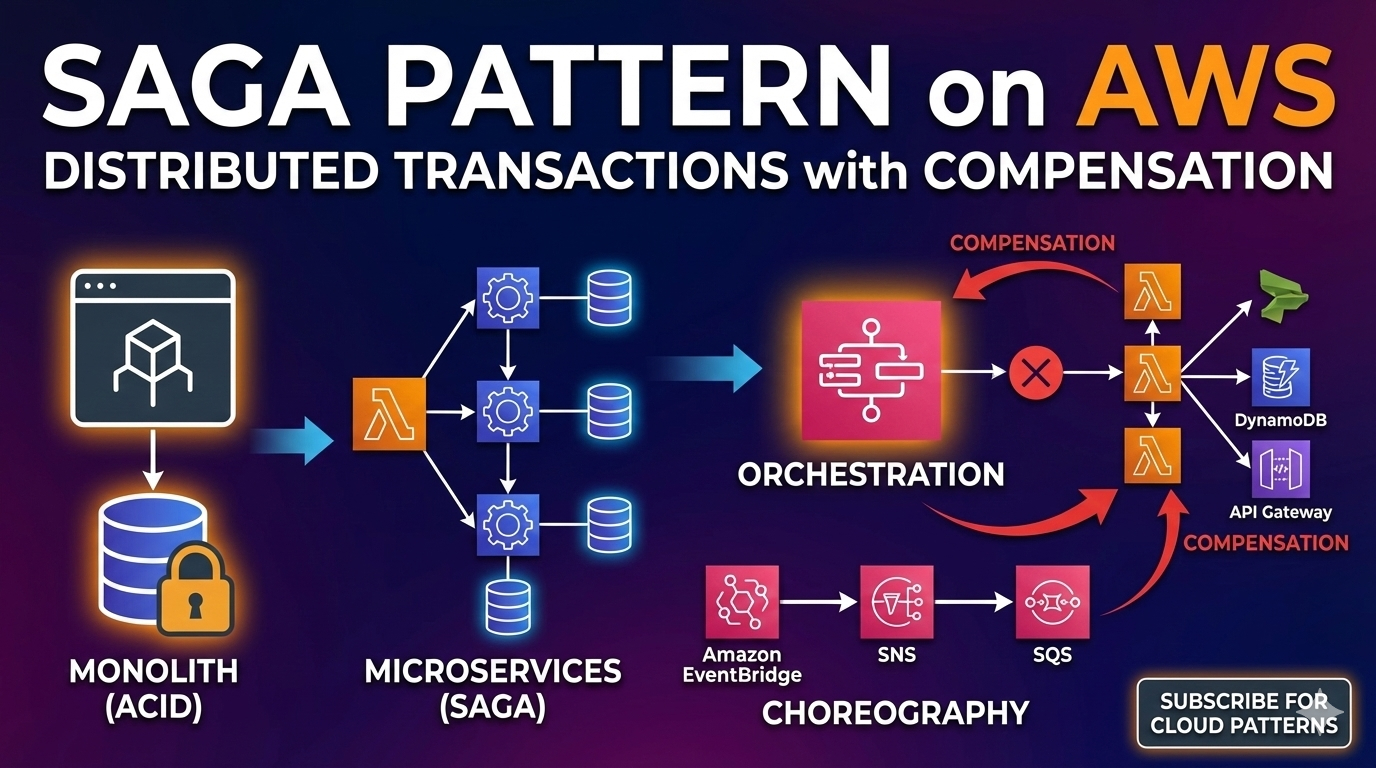
What you’ll learn
- What the Saga pattern is (and what it is not)
- Why compensation matters for distributed transactions
- Multiple AWS implementations: orchestration, choreography, and hybrids
- Practical production tips: retries, idempotency, timeouts, DLQs, observability
The problem: distributed transactions without a 2PC
In a monolith, you might wrap changes in a single database transaction. In microservices (or distributed systems), a single business action often spans multiple components:
- The order service writes an order.
- Inventory service reserves stock.
- Payment service charges a card.
- Shipping service creates a shipment.
You can’t easily use a single ACID transaction across multiple independent datastores and services (and you generally shouldn’t).
Saga is a pattern to achieve end-to-end business consistency using:
- A sequence of local transactions
- And, when something fails, compensating actions are taken to undo prior steps
Saga in one sentence
A Saga is a distributed workflow composed of local transactions, where failures are handled by running compensating steps to restore the system to a consistent business state.
Key idea: You trade strong, immediate consistency for eventual consistency with explicit recovery logic.
Two common styles of Saga
1) Orchestration (central coordinator)
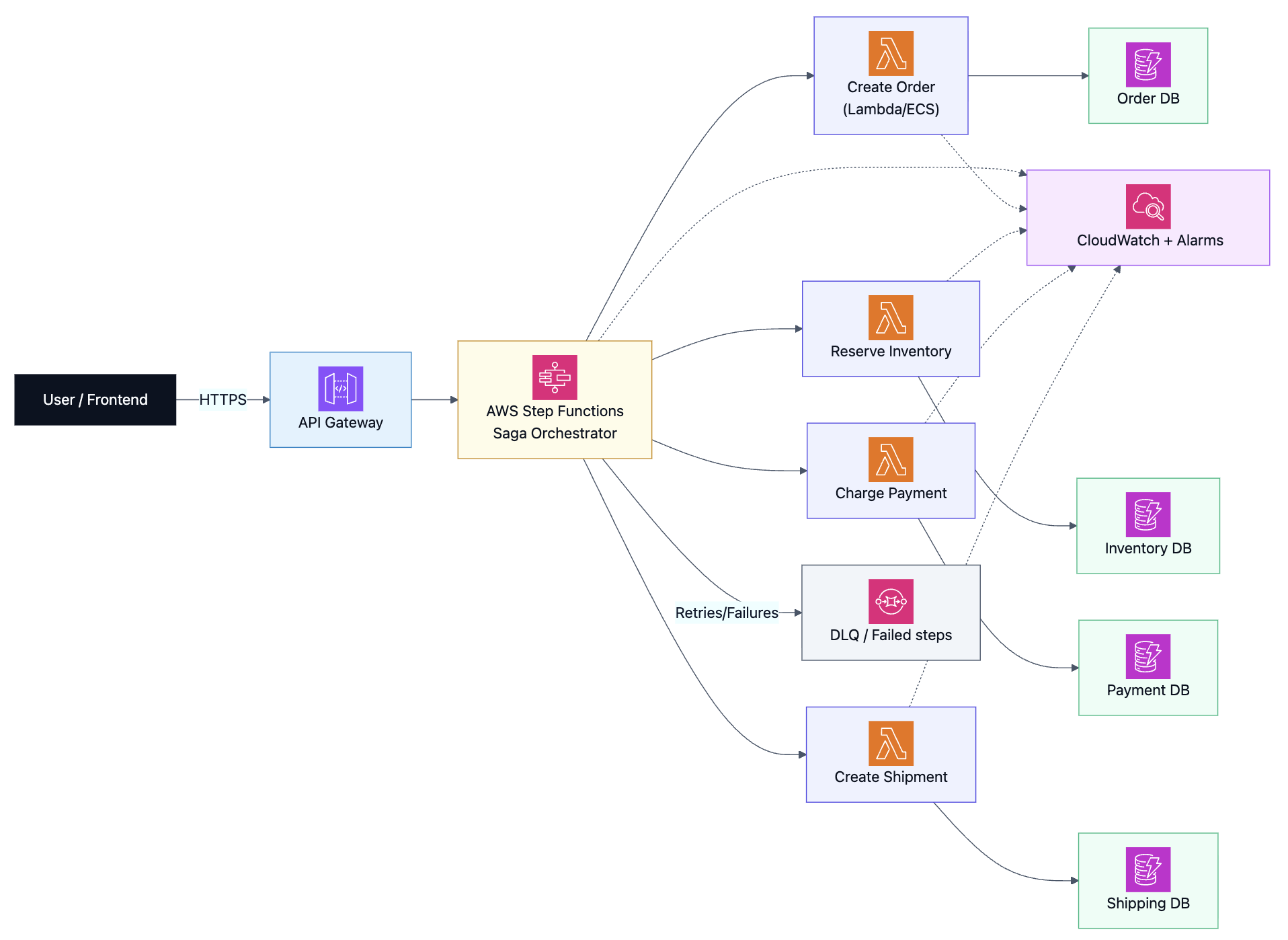
One component coordinates the workflow, decides what runs next, and triggers compensations on failure. On AWS, the most common orchestrator is AWS Step Functions.
2) Choreography (event-driven)
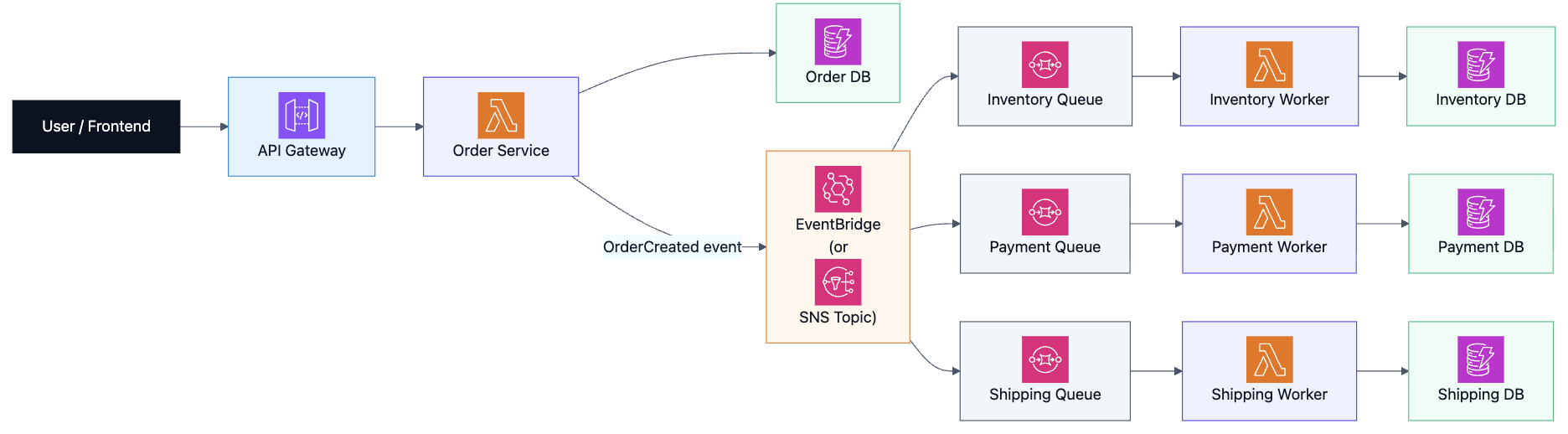
There is no central coordinator. Services publish events, and other services react. On AWS, this is commonly done with Amazon EventBridge, SNS, and SQS.
Option A: Orchestrated Saga with Step Functions (recommended starting point)
When it’s a great fit
- You want a clear “single place” to see the workflow
- You need long-running transactions (minutes/hours) with timeouts and retries
- You want explicit compensation logic and observability
High-level architecture (orchestration)
What compensation looks like (the core of Saga)
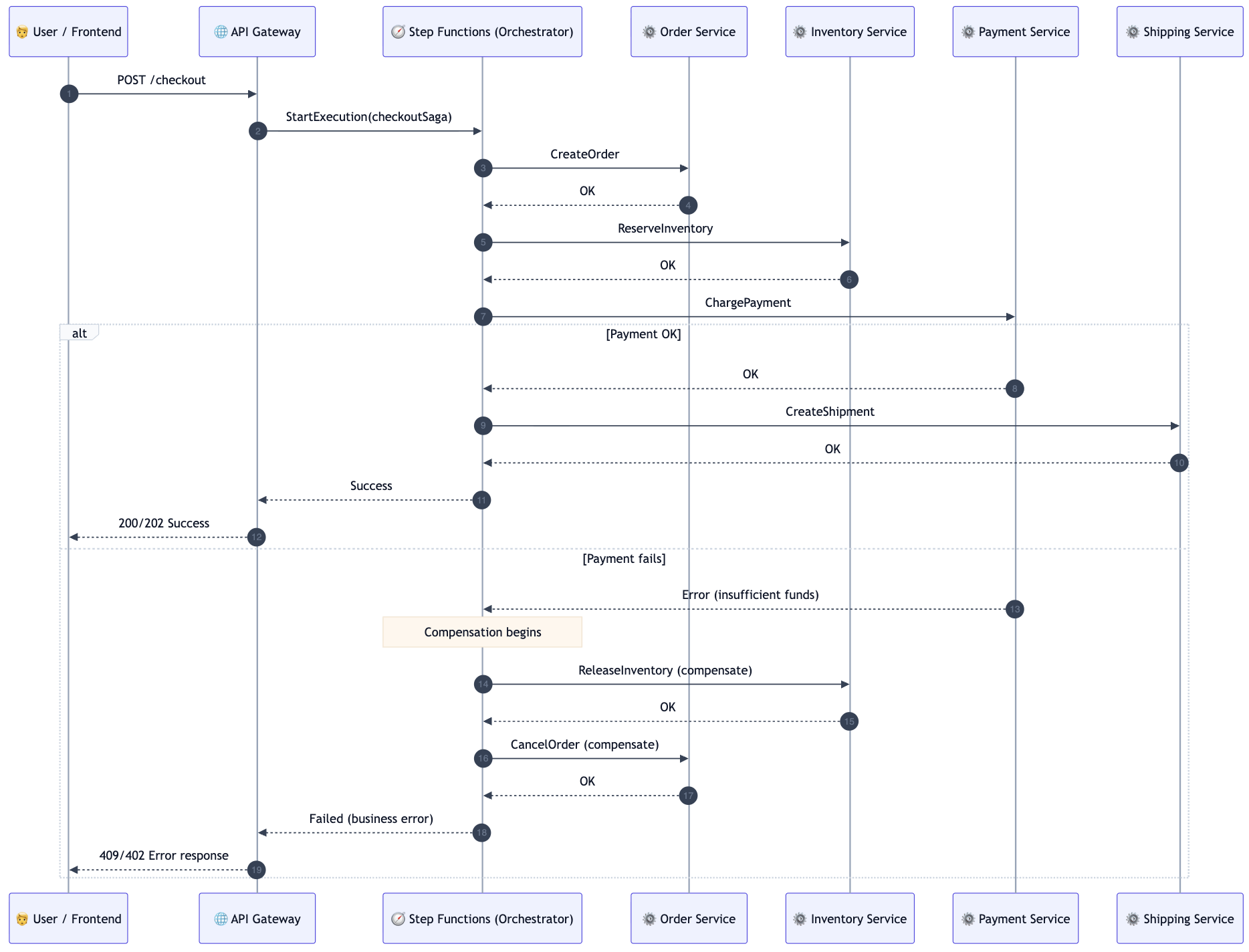
Each forward step should have a defined rollback (when rollback is possible):
- ReserveInventory → ReleaseInventory
- ChargePayment → RefundPayment (or VoidAuthorization)
- CreateShipment → CancelShipment
Some operations are not truly reversible. In those cases, your compensation is a business action:
- Notify a human
- Issue credit
- Create a “fix-up” task
Orchestrated Saga sequence (success + compensation)
Option B: Choreography Saga (Event-driven with EventBridge/SNS/SQS)
When it’s a great fit
- You want each service to stay autonomous and “react to events.”
- Workflows are flexible and evolve often
- You want loose coupling (but accept more complexity in debugging)
Typical AWS building blocks
- Event bus: EventBridge (or SNS topics)
- Durable buffering: SQS queues per consumer (fan-out + backpressure)
- Workers: Lambda or ECS tasks
- Outbox pattern (recommended): ensure events are reliably published when the local transaction commits
Architecture (choreography)
How compensation works in choreography
Compensation is also event-driven:
- PaymentFailed → InventoryReleaseRequested, OrderCancelRequested
- ShippingFailed → RefundRequested, InventoryReleaseRequested
This style is powerful, but you must invest more in:
- Event versioning
- Replayability
- Observability and correlation IDs
Option C: Hybrid Saga (Step Functions + events)
Very common in real systems:
- Use Step Functions for the core “checkout” workflow
- Publish domain events (OrderConfirmed, PaymentCaptured) for downstream consumers
This gives you:
- a straightforward workflow for the critical business path
- an event-driven architecture for everything else
Production checklist
1) Idempotency everywhere
At least once delivery and retries are expected.
- Use an idempotency key per saga step (often
sagaId + stepName) - Make writes safe to retry
2) Timeouts and retries per step
Different steps need different policies:
- ReserveInventory: short retry window
- Payment: careful retries (avoid double charge)
- Shipping: longer timeouts (external providers)
3) Dead-letter queues and manual recovery
Have a “break glass” plan:
- DLQs for async consumers
- an operator dashboard or runbook to replay/fix stuck sagas
4) Observability and traceability
Minimum:
- log
sagaId,orderId,correlationIdeverywhere - CloudWatch alarms on failure rates and DLQ depth
- Use AWS X-Ray/OpenTelemetry for tracing where possible
5) Data model choice: prefer state machines over flags
Track a saga state explicitly:
- PENDING → INVENTORY_RESERVED → PAYMENT_CAPTURED → SHIPPED
- with timestamps and last error details for debugging
When Saga is the right tool
Use Saga when:
- You have a multi-step business process across services
- You can tolerate eventual consistency
- You’re willing to define compensation logic
Avoid Saga when:
- You truly need strict atomicity across multiple resources
- You can keep the transaction within a single service/database
Auto Amazon Links: No products found.